

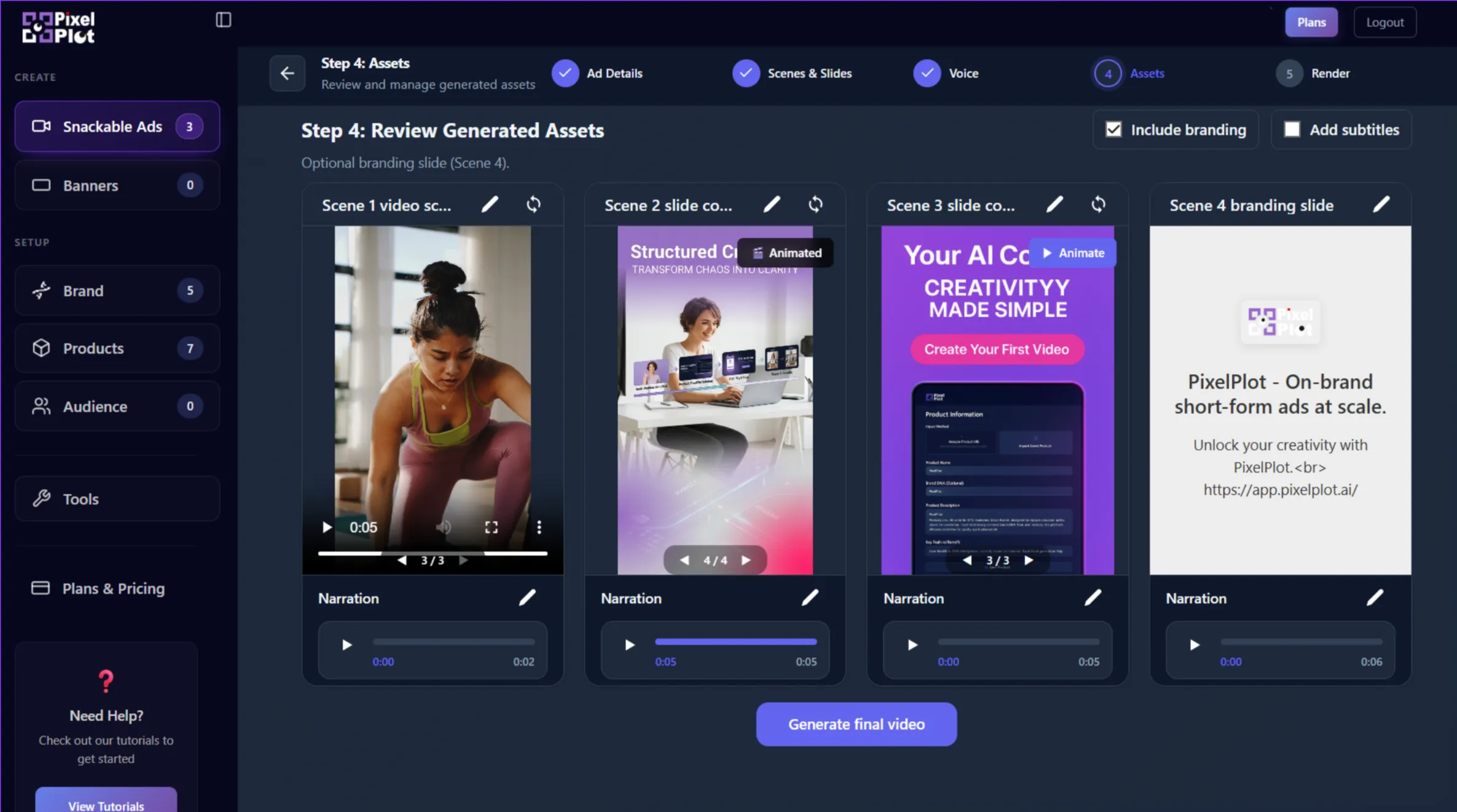
Growth teams and agencies are drowning in scattered design tools, often spending days editing a single short-form video ad. This guide explains how the pixelplot ai ad tool solves the “messy creative stack” problem by acting as a strategic AI co-pilot rather than a black-box generator. Unlike traditional AI tools that spit out unpredictable, off-brand content, Pixelplot uses a structured 4-scene engine to guarantee 100% brand-compliant ads. By the end of this breakdown, you will understand how the 4-scene Snackable Ad framework operates, see real-world workflows for DTCs and agencies, and know exactly how to scale your video ad production without sacrificing brand safety.
What Exactly is the Pixelplot AI Ad Tool?
The Pixelplot AI ad tool is a specialized creative co-pilot that transforms basic inputs—like product URLs or raw assets—into structured, high-performing short-form video ads. It replaces fragmented creative software with a single, predictable generation engine designed specifically for direct-response marketing.
We built Pixelplot because our team was exhausted by the standard ad creation workflow. Because we were bouncing between copywriting tools, stock footage libraries, and complex timeline editors, frequently spending three full days just to finalize one mediocre video asset. Then we quickly realized that having access to design tools does not equal having an ad strategy. And we didn’t need another open-ended video editor; we needed an AI co-pilot for short-form video that actually understood performance marketing.
Traditional generative AI presents a massive risk for brands: lack of control. Pixelplot eliminates this risk by combining artificial intelligence with strict structural guardrails.
Pixelplot vs. Traditional AI Video Generators
| Feature | Pixelplot AI Co-Pilot | Traditional “Black-Box” AI Generators |
|---|---|---|
| Output Control | Modular, editable 4-scene structure. | Unpredictable, prompt-based generation. |
| Brand Safety | Locks in fonts, colors, and approved assets. | High risk of off-brand hallucinations. |
| Primary Use Case | Direct-response video ads and rapid A/B testing. | Generic social media posts and b-roll. |
| Workflow | Replaces the entire fragmented creative stack. | Requires export to third-party editing tools. |
How the 4-Scene Snackable Ad Framework Works
The 4-scene Snackable Ad framework is a proven, direct-response video structure consisting of a Hook, Problem, Solution, and Call-to-Action. Pixelplot automates the assembly of these specific scenes to ensure the final output drives conversions rather than just passive views.
This framework solves the biggest fear brands face when scaling creative output: maintaining brand integrity. By segmenting the video into four distinct, editable blocks, you generate brand compliant AI ads every single time. The AI handles the heavy lifting of asset assembly and pacing, but you maintain absolute control over the narrative flow.
The engine breaks every video down into these four modular components:
- The Visual Hook (0–3 seconds): Grabs attention immediately using striking visuals, rapid motion, or a bold text overlay. This scene interrupts the scroll.
- The Problem / Agitation (3–7 seconds): Highlights the specific pain point your target audience faces. It creates empathy and relevance.
- The Solution / Product Reveal (7–12 seconds): Introduces your product as the natural answer to the established problem. It highlights core features and value propositions.
- The Call-to-Action (12–15 seconds): Directs the viewer to take a specific, measurable next step, such as clicking a link or claiming an offer.
Because the scenes are modular, marketers can swap out individual elements instantly. You can test five different visual hooks against the exact same core video without needing to re-render the entire project from scratch.
How Different Teams Use Pixelplot for Scale
Different marketing functions require different creative velocities and workflows. Here is how specific user profiles integrate Pixelplot into their daily operations to drive growth.
DTC Brands and Startups: Turning Links into Ads
Founders and startup growth leads need to launch campaigns fast, often without the budget for a dedicated, in-house video team. With Pixelplot, operators can bypass the blank page entirely and turn product pages into video ads in minutes.
Consider the launch of the SunGlow smart lamp. Instead of waiting on a two-week production cycle, the DTC brand’s growth lead simply inputted their Shopify URL into the Pixelplot engine. The AI instantly extracted the product images, benefits, and branding guidelines. Within five minutes, the platform populated the 4-scene framework, delivering a test-ready, 15-second video ad perfectly formatted for TikTok and Meta Reels.
Marketing Agencies: Rapid A/B Testing
Agencies manage multiple client accounts where creative fatigue sets in quickly and performance drops off. For media buyers running high-budget campaigns, speed is safety; faster creative iteration dramatically lowers the risk of ad fatigue and wasted ad spend.
An agency running user acquisition for a new fintech app used Pixelplot to instantly generate five distinct ad angles from a single brief. Instead of submitting a ticket to the creative department and waiting a week, the media buyer used the tool to generate variations focusing on entirely different hooks—price, convenience, and security. This enabled them to launch A/B tests on day one of the campaign and scale the winning creative immediately.
Moving Beyond the Messy Creative Stack
Relying on a dozen disconnected tools creates workflow bottlenecks and inconsistent messaging. Pixelplot centralizes the entire DTC video ad automation process into one dashboard.
We firmly believe in our philosophy on human-guided AI co-creation. The AI should handle the tedious tasks of asset assembly, timeline formatting, and text animation, while the human marketer retains total strategic control over the messaging and brand guidelines. This structured approach ensures you never publish an AI short-form video generator hallucination, keeping your campaigns profitable and your brand reputation safe.
Frequently Asked Questions
Is the AI content actually brand-compliant?
Yes. Pixelplot locks in your specific brand guidelines, fonts, hex codes, and approved visual assets before generation begins. The rigid 4-scene framework ensures the AI cannot hallucinate outside of your designated corporate guardrails.
Do I need video editing experience to use the 4-scene framework?
No video editing experience is required. The platform operates as a strategic co-pilot, allowing you to swap scenes, adjust text overlays, and change pacing through a simple, modular clickable interface rather than a complex timeline editor.
Can I test multiple hooks simultaneously?
Absolutely. You can lock in scenes 2, 3, and 4, and prompt the AI to generate multiple variations of the initial visual hook. This feature enables rapid A/B testing of the most critical part of your ad without forcing you to recreate the entire video from scratch.
Stop treating your creative pipeline like a bottleneck. Build your first campaign using the Pixelplot Snackable Ad framework.
[…] When implementing the 4-scene short-form ad structure, you replace creative chaos with a predictable conversion engine. […]