


For DTC marketers and media buying agencies, keeping up with the content demands of modern social platforms feels like a never-ending treadmill. The algorithm demands a constant stream of fresh, engaging video creatives to prevent ad fatigue. You cannot simply shoot one commercial, slice it into three parts, and expect to scale your revenue. This intense pressure has led top-tier growth teams to embrace tiktok ads ai as the primary engine for their creative production. By integrating artificial intelligence into your workflow, you can stop fighting the content bottleneck and start launching data-driven campaigns at unprecedented speeds.
This guide breaks down exactly how modern marketing teams are leveraging artificial intelligence to build, test, and scale native video campaigns without sacrificing their unique brand identity.
The Crushing Reality of Creative Fatigue
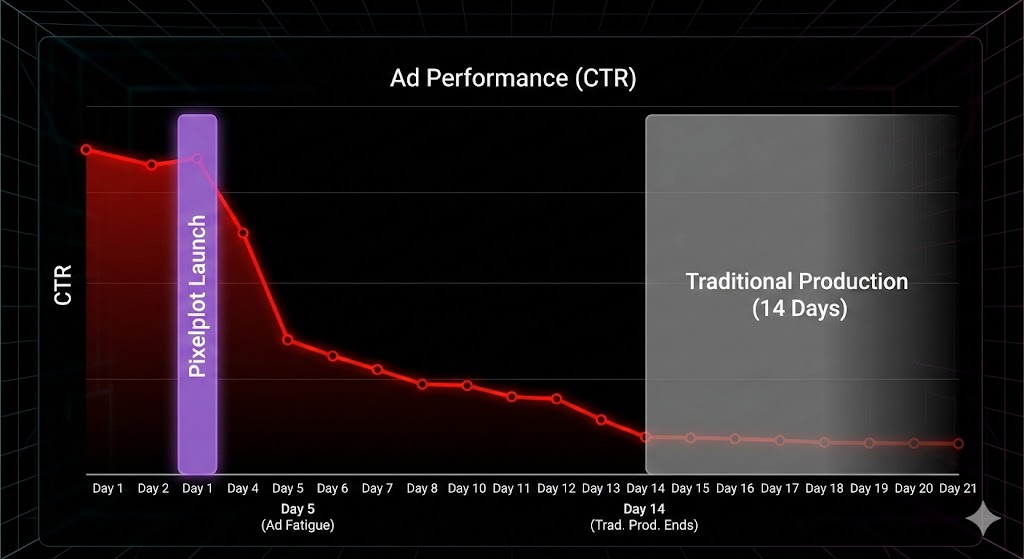
Before diving into the technology, we must understand the core problem plaguing digital advertisers today. Paid social platforms—especially short-form video networks—burn through creative assets faster than any other medium in advertising history. A video that drives a massive spike in conversions on Monday might suffer a complete drop-off in click-through rates by Friday.
Audiences scroll at lightning speed and have developed a subconscious filter for anything that looks like traditional advertising. If your video does not hook them in the first two seconds, they swipe away, and you pay for an impression that yields zero return. Manual production simply cannot keep pace with this environment.
Planning a traditional shoot, hiring creators, scripting manually, and editing raw footage takes weeks. By the time your new creatives hit the ad account, the trend you wanted to capitalize on is completely dead. Marketing teams need a way to generate dozens of high-quality variations in hours, not months.
What Artificial Intelligence Actually Does for Video Production
Many marketers mistakenly believe that AI video generation means clicking a single button and receiving a fully polished, ready-to-run commercial. In reality, the most effective teams use technology as a highly specialized co-pilot. It handles the heavy lifting of ideation and structuring while humans provide the strategic direction.
Generating Scroll-Stopping Hooks
The hook is arguably the only part of your video that truly matters. If you fail to capture attention immediately, the rest of your script is irrelevant. Machine learning tools excel at analyzing thousands of viral video structures to understand exactly what stops a user from swiping.
Instead of your copywriter staring at a blank screen trying to invent a new angle, your software can instantly generate twenty different hook variations based on your product’s core value proposition. You can easily prompt the system to write hooks focused on specific pain points, surprising statistics, or polarizing statements. This gives your creative team a massive library of starting points to test against cold audiences.
Writing Native Scripts That Sound Human
A major pitfall for brands trying to scale is writing ad copy that sounds like a corporate press release. Users on short-form platforms expect authentic, conversational language that feels native to the app experience. Advanced generation tools understand this nuance and can adapt their output to match platform-specific cultures.
You can feed a static product detail page into a scripting assistant and ask it to output a user-generated content (UGC) style script. The software will strip away the corporate jargon and replace it with natural phrasing, pacing cues, and engaging transitions. Your team then simply reviews and refines the draft rather than writing it from scratch.
Mapping Out Scene Structures and Storyboards
Writing the spoken words is only half the battle. Video is a visual medium, and your ad needs a tight, logical progression of images to keep the viewer engaged. Innovative tools now offer automated storyboarding that pairs your script with specific visual directions for every single second of the ad.
The system will break down a 15-second script into distinct visual scenes. It might suggest starting with a tight close-up of the product texture, cutting to a wide shot of the user applying it, and finishing with a text-heavy call to action. This level of granular planning ensures that whoever is shooting or editing the final video has a crystal-clear blueprint to follow.
The 4-Scene Snackable Ad Framework
Structuring your content correctly is the secret to making automation work for your business. Feeding generic prompts into a language model will result in rambling, unfocused videos that fail to drive conversions. Top agencies bypass this issue by forcing their software to adhere to strict psychological frameworks.
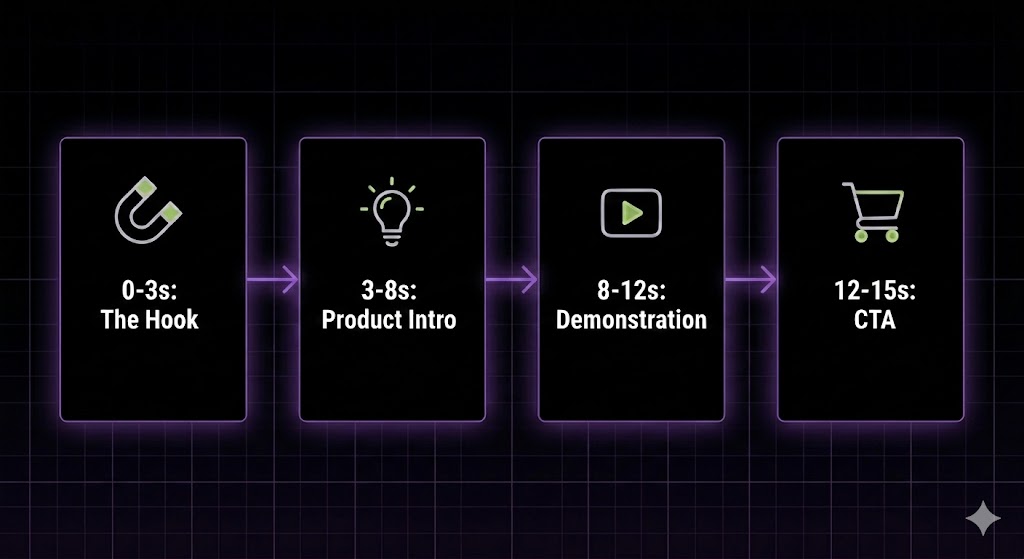
The most reliable structure for short-form video is the 4-scene “Snackable” format. This framework provides a rigid skeleton that artificial intelligence can easily populate with creative variations.
- The Hook (Seconds 0-3): A visual and auditory pattern interrupt that directly calls out the target audience or their specific problem.
- The Product Intro (Seconds 3-8): Seamlessly introducing your brand as the logical solution to the problem established in the first scene.
- The Demonstration (Seconds 8-12): Showing the product in action to build trust and prove the claims made earlier in the video.
- The Call to Action (Seconds 12-15): A clear, unambiguous directive telling the viewer exactly what to do next, often paired with subtle brand logos.
When you train your digital co-pilot to write exclusively within this 4-scene structure, you guarantee that every generated script has a logical flow optimized for direct response marketing.
Maintaining Brand Voice at High Velocity
The most common objection to adopting automated creative workflows is the fear of brand dilution. Premium DTC founders worry that machine-generated copy will sound generic, cheapening the customer experience. This is a valid concern if you are using basic, untrained models out of the box.
The solution lies in providing comprehensive Brand DNA upfront. You must treat your software like a newly hired junior copywriter who needs to read your brand guidelines before touching a keyboard. You provide the system with your unique selling propositions, your list of banned words, your specific tone of voice, and your ideal customer avatars.
Establishing this foundational context unlocks several massive benefits for your creative team:
- Absolute Consistency: Every script generated adheres to your established tone, whether it is clinical and authoritative or playful and sarcastic.
- Faster Approval Cycles: Because the drafts start much closer to your actual brand voice, internal review times drop significantly.
- Audience Resonance: The copy speaks directly to the specific pain points of your target demographic rather than using broad, generic marketing speak.
- Reduced Hallucinations: Strict guidelines prevent the system from inventing features or making compliance-breaking claims about your products.
The Human-in-the-Loop Workflow
Achieving peak performance requires a hybrid approach. You rely on machines for speed and volume, but you rely on human marketers for empathy and final polish. The technology provides the raw materials, and your media buyers act as the ultimate editors.
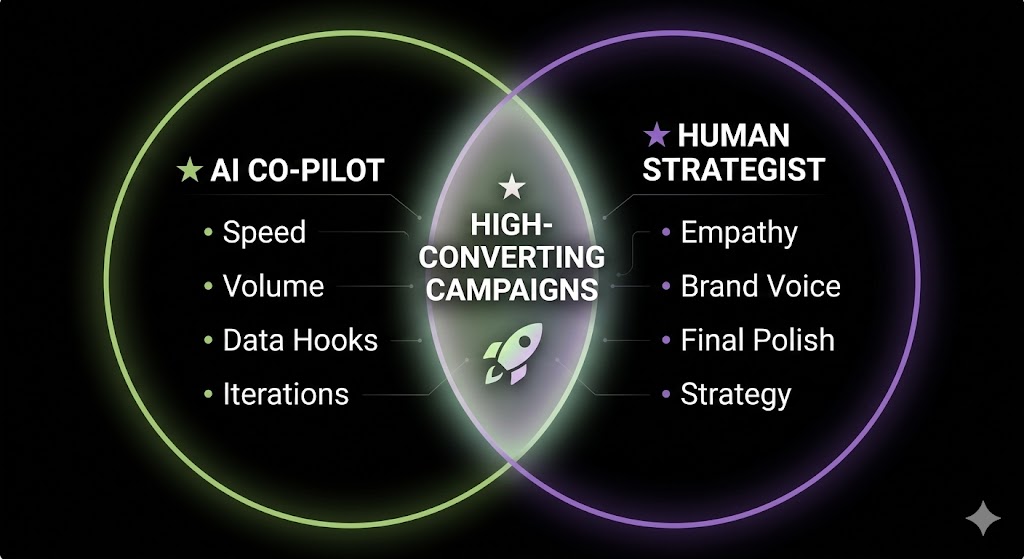
If a generated script feels slightly too aggressive for your demographic, a human editor steps in and softens the language. If a suggested visual hook feels physically impossible to shoot on your current budget, your creative director swaps it for something more practical. This collaborative loop ensures you get the output volume of an agency ten times your size while maintaining the quality control of a boutique firm.
Accelerating Creative Testing for Agencies and DTCs
Finding a winning ad concept is a numbers game. You cannot predict which specific hook or visual angle will resonate with the algorithm on any given day. You simply have to test as many high-quality variations as your budget allows and let the platform’s data declare the winner.
Agencies managing multiple client accounts feel this pressure exponentially. They need to launch fresh testing batches for different brands simultaneously. Using automated creative assistants completely changes the math on how many variants an agency can produce in a single sprint.
Instead of writing three concepts for a client pitch, an agency can easily generate fifteen distinct angles targeting different consumer psychological triggers. They might test an “us versus them” comparison ad against a purely educational tutorial ad. This velocity allows media buyers to isolate winning variables and drop their cost per acquisition (CPA) rapidly.
Scaling these testing cycles provides several distinct operational advantages:
- Rapid Data Collection: Launching more variants simultaneously means you gather statistical significance on what works faster.
- Isolating Variables: You can test the exact same video script with three different opening visual hooks to see which one retains.
- Extending Ad Lifespans: When a winning ad starts to fatigue, you instantly generate subtle variations to refresh the creative without starting from scratch.
- Client Retention: Agencies that can consistently provide high volumes of fresh, data-backed creatives naturally retain their clients much longer.
Step-by-Step: From Product Page to Video Campaign
Understanding the theory is useless without execution. Here is a practical workflow showing how modern brands actually use these tools to build a campaign from scratch in a single afternoon.
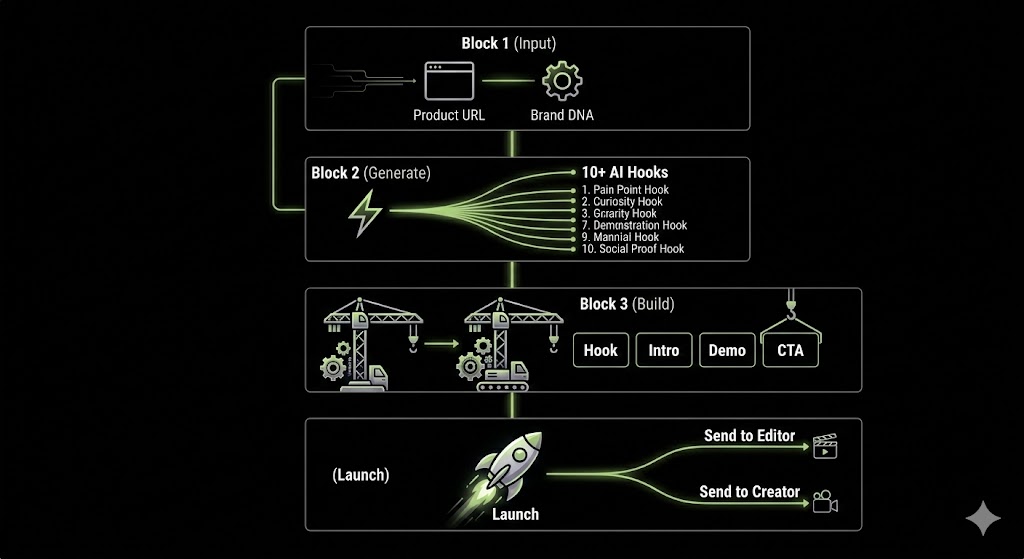
Step 1: Ingestion and Briefing
You start by feeding the core data into your platform. You paste the URL of your product detail page and input your specific Brand DNA guidelines. You tell the system you want to target young mothers dealing with sleep deprivation and that the tone should be empathetic and reassuring.
Step 2: Hook Generation
You prompt the system to generate ten different hook ideas based on the provided brief. The software outputs text hooks ranging from “Tired of looking as exhausted as you feel?” to “The five-minute morning routine saving my sanity.” You review the list and select the three strongest options to move forward with.
Step 3: Building the Scene Structure
Taking those three winning hooks, you ask the software to flesh them out into full 4-scene Snackable Ads. The system pairs your hooks with specific product demonstration scenes and calls to action. It outputs a complete storyboard detailing exactly what text appears on screen, what the voiceover says, and what the visual action should be.
Step 4: Visual Polish and Assembly
With the blueprints finalized, your creative team gathers the necessary assets. Use background removal tools to clean up your product photography. You hand the final storyboards and assets to a video editor or a UGC creator, knowing the underlying strategy is optimized for success.
Overcoming the Blank Page Syndrome
Creative block is one of the most expensive hidden costs in digital marketing. Paying a team of writers to sit in a room brainstorming ideas often yields diminishing returns as the hours tick by. Technology eliminates this friction entirely by providing an endless stream of starting points.
Your team never has to stare at a blank Google Doc again. They always have a rough draft to critique, edit, and improve. It is infinitely easier for a human to edit a mediocre idea into a brilliant one than it is to pull a brilliant idea out of thin air. This shift transforms your marketing department from content creators into content curators.
They spend their time analyzing data, refining messaging, and thinking about high-level strategy. The tedious execution of writing out shot lists and formatting text overlays is delegated entirely to the software.
Preparing for the Future of Paid Social
The digital advertising ecosystem will only become more fragmented and demanding. Platform algorithms will continue to prioritize accounts that upload fresh, highly relevant content consistently. Brands that stubbornly cling to slow, manual production cycles will find themselves priced out of the auction as their engagement rates plummet.
Adapting your internal processes to include intelligent automation is no longer an optional growth hack. It is a fundamental requirement for staying competitive in the DTC space. The most successful brands of the next decade will be those who figure out how to combine deep human empathy with machine-level execution speed.
They will build proprietary databases of what specific phrases, colors, and pacing metrics drive conversions for their unique products. They will feed that data back into their systems to make every subsequent campaign smarter and more efficient than the last. This creates a compounding advantage that competitors simply cannot replicate with money alone.
Mastering TikTok Ads AI: The New Standard for DTC Growth
Thriving in the modern ecommerce landscape requires agility, and relentless testing. Building a workflow around tiktok ads ai empowers you to meet demands head-on without sacrificing your brand’s integrity. By utilizing structured frameworks, and rapid variant generation, you transform your creative process into a predictable revenue engine. If you are ready to stop guessing explore how integrating purpose-built tools can revolutionize your approach and help you deploy AI ads for TikTok that consistently convert cold traffic into loyal customers.