
AI in CTV Advertising: How Automation and Predictive Analytics are Transforming the Big Screen

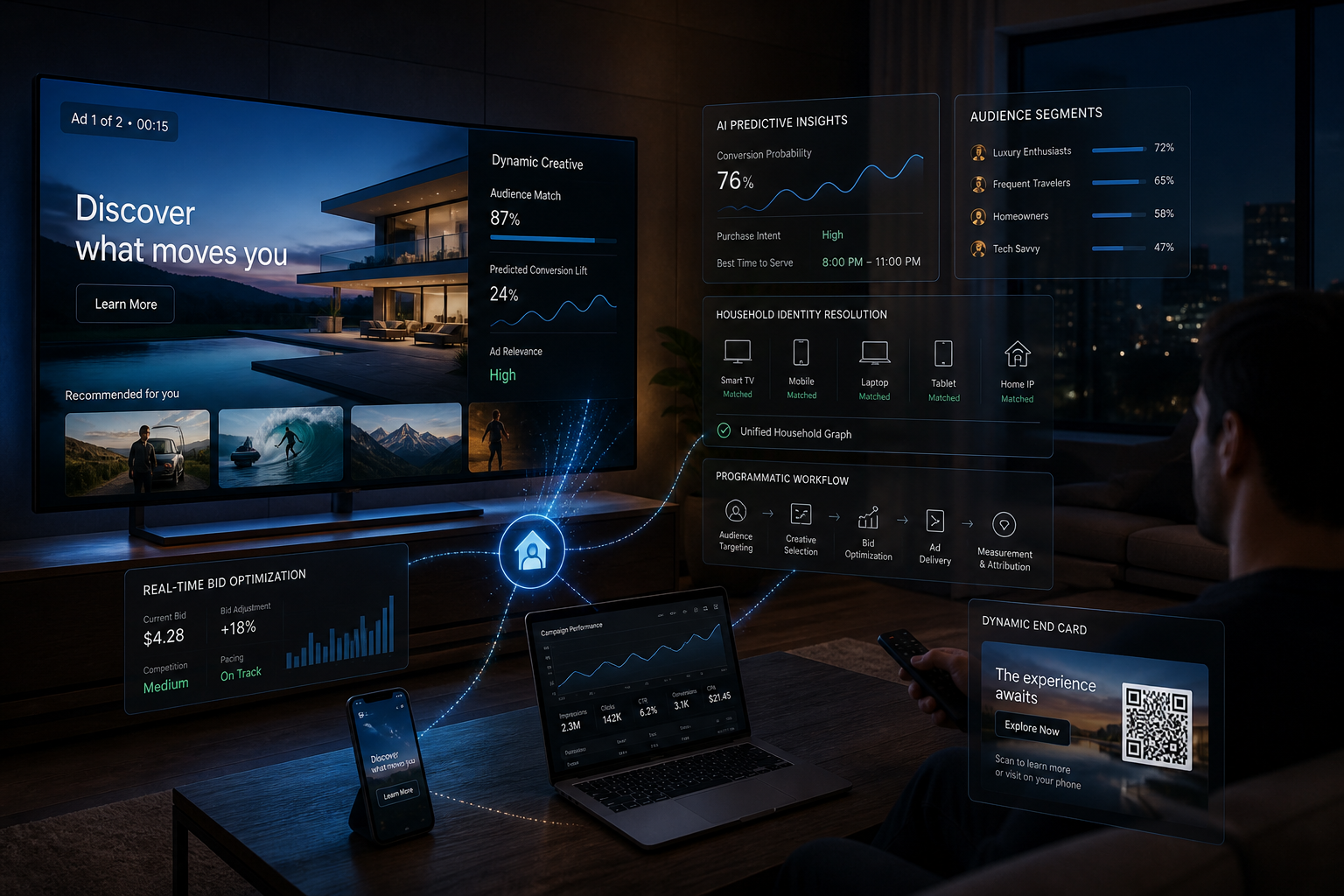
Connected TV (CTV) has officially passed traditional linear television as the primary channel for premium home entertainment. As household viewing habits shift decisively toward streaming platforms, programmatic ad spend on CTV continues to hit record highs. However, CTV advertisers face a unique set of operational challenges: high media costs, fragmented inventory, rigid creative specifications, and legacy measurement loops.
Artificial intelligence is reshaping the CTV media buying and production landscape. From real-time dynamic creative optimization (DCO) to predictive audience modeling, AI enables performance marketers to bring performance-driven agility to the living room screen.
Here is how modern growth teams and agencies leverage AI across their CTV advertising pipelines to drive incremental lift, lower acquisition costs, and scale visual asset production.
The CTV Performance Paradox
CTV combines the visual impact of traditional TV with the targeting precision of digital performance channels. However, running direct-response or performance-driven campaigns on CTV presents three major hurdles:
┌────────────────────────────────────────────────────────┐
│ 1. THE CREATIVE BOTTLENECK                             │
│    High production costs limit creative variations     │
└───────────────────────────┬────────────────────────────┘
                            │
                            ▼
┌────────────────────────────────────────────────────────┐
│ 2. FRAGMENTED ATTRIBUTION                              │
│    Cross-device tracking requires deterministic graphs │
└───────────────────────────┬────────────────────────────┘
                            │
                            ▼
┌────────────────────────────────────────────────────────┐
│ 3. COLD-START INVENTORY BIDDING                        │
│    Manual bid setups struggle with premium CPM costs   │
└───────────────────────────┬────────────────────────────┘
- High Production Overhead: Traditional 16:9 television ads cost tens of thousands of dollars to write, produce, and render, preventing the continuous rapid testing standard on mobile channels.
- Attribution Gaps: Connecting a CTV ad impression on a living room TV to a conversion on a secondary mobile device or desktop requires complex household graph resolution.
- High Floor CPMs: Premium CTV ad inventory carries higher CPMs than social or mobile display. Wasting impressions on unqualified audiences or low-performing creatives deteriorates campaign ROI quickly.
AI addresses each of these friction points by automating creative adaptations, optimizing programmatic bidding parameters in real time, and predicting impression quality before budget is allocated.
4 Ways AI is Reshaping CTV Campaigns
1. Automated Creative Scaling & Localization
Traditionally, creating multiple variations of a 15-second or 30-second CTV ad required back-and-forth editing with external post-production houses. With automated asset scaling, video generation platforms take master assets—such as raw footage, 3D renders, or dynamic motion graphic components—and automatically assemble localized, audience-specific variations.
For global campaigns, AI-driven voiceover generation and automated sub-title alignment allow creative strategists to deploy localized TV creatives across dozens of regional markets simultaneously without re-shooting scene content.
2. Dynamic Creative Optimization (DCO) at Scale
Dynamic Creative Optimization is no longer limited to simple web banners. Modern CTV DCO engines use real-time contextual inputs—such as local weather, regional promotions, viewer time of day, and genre context—to render personalized ad elements dynamically.
For instance, a mobile game or app advertiser running CTV ads can swap out featured gameplay mechanics or end-card offers based on whether the viewer is watching daytime sports vs. late-night comedy, matching the viewer’s current attention profile.
3. Predictive Audience & Inventory Bidding
Programmatic CTV exchanges process millions of ad opportunities per second. Machine learning models evaluate historical impression performance, publisher context, and device telemetry to predict impression value in real time.
Instead of relying on static audience segments, AI bidding algorithms continuously refine targeting strategies based on lower-funnel activity, shifting spend automatically toward inventory streams that yield higher post-view conversion rates.
4. Cross-Device Identity Resolution
Because CTV ads are non-clickable, measuring campaign impact relies on tracking secondary actions (such as downloading an app or visiting a URL on a phone or laptop on the same home network). AI-powered identity graphs continuously map IP addresses, device signatures, and household data points to match TV impressions to downstream mobile or web events accurately.
Bridging the Gap: Social Video to Connected TV
One of the biggest efficiencies for growth teams today is repurposing high-converting short-form creative frameworks for CTV environments.
While mobile platforms like TikTok rely on vertical (9:16) framing and ultra-fast cuts, the core direct-response triggers—clear visual hooks, clear value props, and explicit Call-to-Actions (CTAs)—remain identical when adapted to horizontal (16:9) CTV feeds.
┌───────────────────────────────────────────────────────────┐
│              CROSS-CHANNEL CREATIVE WORKFLOW              │
├─────────────────────────────┬─────────────────────────────┤
│ TikTok / Mobile Format      │ Connected TV (CTV) Format   │
├─────────────────────────────┼─────────────────────────────┤
│ 9:16 Vertical Aspect        │ 16:9 Horizontal Aspect      │
│ Fast 3-Second Audio Hook    │ Visual Hook + QR Endcard    │
│ Native Caption Overlays     │ Hi-Res Motion Graphics      │
└─────────────────────────────┴─────────────────────────────┘
Using specialized automation engines, teams can take winning script hooks developed for platforms like TikTok or mobile networks and automatically adjust visual framing, text safety margins, and resolution output to meet broadcast-ready CTV technical requirements.
If you are currently optimizing mobile video pipelines, check out our guide on leveraging AI ads for TikTok to see how modular hook testing translates across automated video workflows.
Best Practices for AI-Driven CTV Ad Execution
To maximize return on ad spend (ROAS) when introducing AI automation into your CTV marketing stack, follow these core execution principles:
A. Integrate Interactive End-Cards and QR Codes
Because viewers cannot tap a CTV screen directly, your creative end-cards must provide an immediate path to conversion. AI tools can dynamically generate and position high-contrast QR codes alongside explicit, time-sensitive incentives (e.g., “Scan now to claim 500 bonus coins” or “Scan for 20% off”).
B. Standardize Audio-First Storyboarding
Like mobile platforms, CTV viewing is overwhelmingly sound-on. Ensure your AI production workflows script high-quality, broadcast-level audio tracks from frame one. Pair professional AI voiceover synthesis with clear sound effects (SFX) to anchor viewer attention to the TV screen before they look down at their mobile devices.
C. Build Unified Pre-Production Workflows
Avoid siloing your CTV creative strategy from your mobile UA pipeline. Use unified storyboards to design modular campaign assets that can be rendered simultaneously into vertical (9:16) formats for social channels and high-definition horizontal (16:9) formats for CTV streaming apps.
For a deeper dive into streamlining your pre-production pipeline across channels, explore our complete breakdown on building a high-converting TikTok ad storyboard template.
Technical Performance Checklist for CTV Ads
When preparing AI-generated video assets for programmatic CTV DSPs (such as Trade Desk, DV360, or Roku Advertising Framework), ensure your output files match these technical specs:
| Parameter | Standard CTV Specification | AI Optimization Focus |
|---|---|---|
| Aspect Ratio | 16:9 Widescreen | Auto-reframing central focus subjects |
| Resolution | 1080p (1920×1080) or 4K UHD | Upscaling asset resolution without artifacts |
| Frame Rate | Constant 23.976, 25, or 29.97 fps | Frame-interpolation for smooth playback |
| Audio Loudness | −24 LKFS/LUFS (±1 LU) | Auto-normalizing synthesized voiceovers |
| File Format | MP4 / MOV (H.264 / ProRes) | Clean programmatic transcode validation |
| Duration | 15s or 30s exact cuts | Automated pacing & edit truncation |
Accelerate Your Multi-Screen UA Strategy
The future of TV advertising isn’t reserved for multi-million-dollar brand budgets. By incorporating AI into your creative strategy and production funnel, performance teams can produce broadcast-ready CTV creatives with the same speed, iteration frequency, and testing rigor previously reserved for mobile app marketing.
Ready to automate your creative generation across video channels? Explore how PixelPlot helps game studios and performance marketers scale direct-response video ad assets across mobile, social, and digital video networks.