
Why Meta and TikTok Ads Are Dying Faster in 2026 (And How to Fix Ad Fatigue)

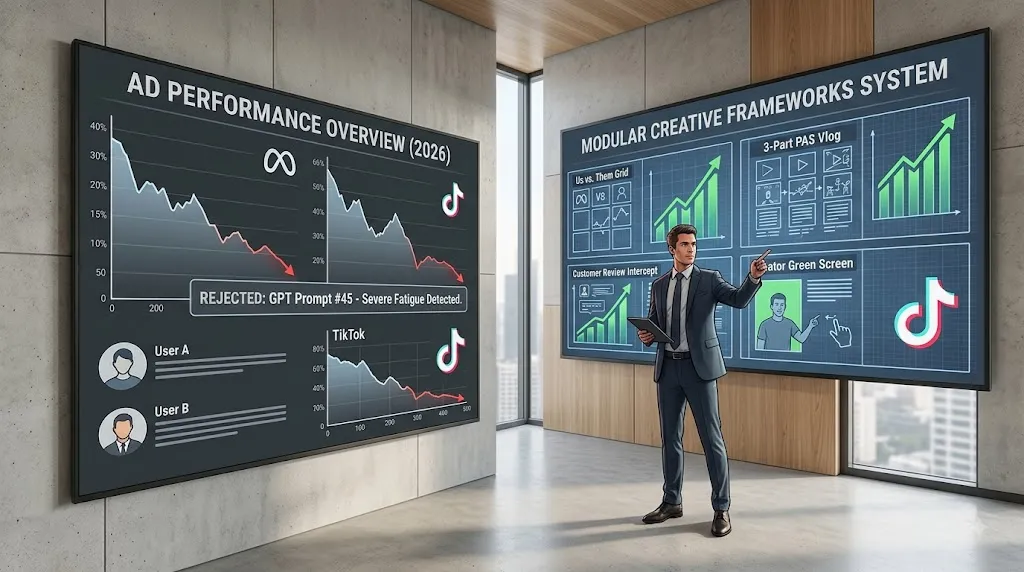
We’ve all been there. You finally nail a video creative. You launch the campaign, the initial ROAS spikes, your cost per acquisition (CPA) is exactly where you want it, and for 72 hours, you feel like an absolute genius.
Then, the floor falls out.
By day four, your click-through rate (CTR) slides. By day seven, your CPMs are creeping up, and by day ten, you are pausing the ad because it’s actively burning money.
If this cycle feels faster and more aggressive lately, you aren’t imagining things. In 2026, scaling paid social isn’t a media-buying problem anymore; it is entirely a creative pipeline problem. With automated campaign types like Meta Advantage+ and TikTok Smart+ handling bidding and targeting with ruthless efficiency, the algorithms are churning through visual assets at an unprecedented speed.
So, how do you keep your campaigns profitable without burning out your design team or shooting 50 new videos a week?
Let’s break down exactly what ad fatigue looks like right now, why outdated AI workflows are failing, and the structural pipeline you need to stay ahead.
What Exactly Is Ad Fatigue in 2026?
To fix the problem, we first have to agree on what it is.
Ad fatigue is the audience-level performance decay that happens when the same creative concept reaches the same people too many times, causing them to tune out.
However, many media buyers conflate ad fatigue with creative fatigue. The distinction matters because the diagnosis and the fix sit on entirely different sides of the funnel.
- Creative fatigue happens at the asset level. When a single video loses novelty, people stop watching past the first three seconds. You see this when your hook rate collapses, even if the ad is being served to a fresh prospecting audience.
- Ad fatigue happens at the audience level. It is the lagging signal visible in dropping CTRs, rising CPMs, and climbing conversion costs across an entire audience cluster.
In previous years, an evergreen Meta ad could run for weeks or even months. But with Meta’s Andromeda ranking system pushing heavier weights onto creative signals, the burn window has compressed drastically. A single concept that used to last six weeks now burns through an audience in two to three weeks. In fact, recent Meta data shows a 45% CTR drop after just four repetitions to the same user.
Why Does TikTok Ad Fatigue Happen Even Faster?
If you think Meta is moving fast, TikTok operates at light speed.
On Meta, fatigue is largely driven by audience exhaustion from high frequency. But on TikTok, an ad can lose delivery in 48 hours—often before the frequency metric even reaches a 2.0.
Why? Because TikTok fatigue is driven by algorithm suppression. If your video fails to hold attention in the first two to three seconds, TikTok’s algorithm actively cuts your distribution. It doesn’t wait for the audience to see it four times; it simply stops serving the ad and forces you to compete for fewer, significantly more expensive impressions.
What Are the Warning Signs Your Creative Is Dying?
You cannot scale if you are reacting emotionally to a single bad day of performance. You need to watch for specific mathematical signals against a 7-day rolling baseline.
If you are wondering whether to kill an ad or let it ride, look for these four red flags:
1. A 15% Drop in Click-Through Rate (CTR)
This is the cleanest, most reliable signal of audience wear-out because it normalizes for cost. If your CTR slips 15% or more off your 7-day average, the audience has pattern-matched your ad and is actively scrolling past it.
2. Rising CPMs Without Audience Changes
Are your CPMs rising by 10% or more, even though your frequency is low? The auction is telling you that your relevance score has slipped. On TikTok, this is the ultimate sign of algorithmic suppression.
3. A 20% Drop in 3-Second Hook Rate
If your 3-second video view rate launched at 25% and has now slid to 10%, that is not a targeting problem. That is creative fatigue. The asset is dying before you even get to make your pitch.
4. Frequency Pushing Past 3.5 on Cold Traffic
Your prospecting audiences should not see the same ad four times in a seven-day window. If they are, it means you lack creative depth in your ad sets, and Advantage+ is simply hammering the same tired asset to the same pocket of users.
Why Generic AI Can’t Save Your Creative Strategy Anymore
A couple of years ago, when the creative treadmill started speeding up, the industry’s knee-jerk reaction was to use generative text AI to pump out hundreds of video scripts.
But let’s be brutally honest: GPT lost a lot right now when it comes to high-converting marketing output.
Growth teams are realizing that you cannot brute-force your way past a sophisticated algorithm with robotic, generic AI scripts. Basic language models struggle to understand native platform nuance, visual pacing, and the emotional pain points that actually stop a scroll. (It’s a big reason why many performance marketers are migrating their workflows toward Gemini and specialized video architecture platforms rather than relying on standard text prompts).
The audience has evolved. They immediately recognize the cadence of an AI-written script, and they swipe away. Reusing the exact same script but slapping a different stock video behind it doesn’t trick the algorithm either, because the audience pattern-matches the underlying argument, not just the pixels.
The Fix: Modular Production Over Cosmetic Refreshes
If capping frequency doesn’t work, and generic AI scripts are failing, what is the durable fix?
The teams that are successfully beating ad fatigue in 2026 treat creative production as a structural workflow, not a frantic weekly event. They don’t rely on random brainstorming; they rely on modular frameworks.
A modular approach breaks an ad into interchangeable parts:
- The Core Body: The product demo, the problem-solution sequence, or the core value proposition. This is the heavy lifting of the ad.
- The Hook (0-3 seconds): The visual or spoken pattern interrupt that stops the scroll.
- The Call to Action (CTA): The final offer, urgency framing, or closing screen.
Instead of shooting 15 completely different videos from scratch, a smart growth team shoots one highly effective core body, five different hooks, and three different CTA endings. By mixing and matching, you instantly generate 15 distinct variations from a single shoot.
When your ad starts showing the warning signs of fatigue, you don’t have to panic. You already have a new hook variation queued up and ready to rotate into the ad set, passing the baton seamlessly without resetting the algorithm’s learning phase.
5 Frameworks You Can Deploy Right Now
Knowing you need a modular system is one thing; knowing exactly what structures to build is another.
To make this actionable, we’ve mapped out the highest-performing structural templates being used across top-tier DTC and SaaS accounts today. These aren’t just vague ideas—they are systematic matrices where you can plug in your own brand DNA, swap out hooks, and generate infinite assets without burning out your design team.
Want the exact blueprints?
We broke down the pacing rules, the visual setups, and the specific performance metrics you should target for each template in our dedicated guide.
👉 Read the complete breakdown: 5 Winning Ad Creative Frameworks for Scale on Meta and TikTok
In that guide, you’ll discover how to leverage:
- The “Us vs. Them” Comparison Grid: Perfect for visually dismantling competitor claims in a scannable format.
- The PAS (Problem-Agitate-Solve) Vlog: The ultimate native UGC format for humanizing your product and building empathy.
- The Feature Teardown: A high-speed UI walkthrough built specifically for complex SaaS and tech products.
- The Customer Review Intercept: How to turn a static 5-star review into an aggressive, trust-building pattern interrupt.
- The Creator “Green Screen” Reply: The best way to camouflage your ad as an organic, authoritative industry insight.
How Often Should You Actually Refresh Your Creative?
The final piece of the puzzle is cadence. How fast do you actually need to swap these modular pieces in and out? The answer depends entirely on your daily spend and the platform you are buying on.
The Meta Refresh Cadence
- Low Spend ($50 – $200/day): A strong creative can survive for weeks. Refresh every 2 to 3 weeks, and keep an eye on your 7-day rolling CTR.
- Medium Spend ($200 – $1,000/day): Refresh weekly. This is where the modular pipeline becomes mandatory to prevent CPM spikes.
- High Spend ($1,000+/day): You need to inject fresh hook variations every 3 to 5 days to keep Advantage+ fed and acquisition costs stable.
The TikTok Refresh Cadence
Because TikTok suppresses delivery based on early hook failure, the timeline is radically compressed.
- Under $200/day: Refresh every 10 to 14 days. Watch the Average Play Time curve closely in your ads manager.
- Above $500/day: Expect to rotate fresh hooks every 3 to 5 days. TikTok requires raw volume, making it the perfect ecosystem for the 3-part PAS Vlog and the Green Screen Reply frameworks.
Stop Reacting. Start Systematizing.
Ad fatigue is not a bug in the system; it is a permanent feature of automated media buying in 2026. The algorithm is always going to demand fresh creative, and the audience is always going to crave novelty.
The worst thing you can do is treat creative strategy as an afterthought, relying on generic AI tools or waiting until your ROAS is in the red to start brainstorming your next video.
Build a modular pipeline. Track your hook rates religiously. Stop refreshing the cosmetic surface of your ads and start rotating the structural angles. When you load proven frameworks directly into your production engine, you stop fighting the algorithm and start feeding it exactly what it wants.
Ready to systematize your production? Learn how to structure your next shoot with our 5 Winning Ad Creative Frameworks and scale your accounts without the creative burnout.