
50 TikTok Ad Hooks That Stop the Scroll: The Ultimate Swipe File

Running TikTok ads feels like trying to catch lightning in a bottle. You have less than two seconds to stop a user from scrolling past your content. If you fail to “thumb-stop” them, nothing else—your message, your product, or your offer—matters.
This isn’t hyperbole; it is the fundamental reality of performance marketing on vertical video platforms.
The average human attention span is shrinking, and on a platform like TikTok, where dopamine is only a swipe away, the friction to skip content is almost zero. This guide provides more than just a list of catchphrases. It is a comprehensive system designed for rapid testing and performance optimization. You will receive 50 distinct ad hooks, categorized by psychological trigger, ready for use.
The Architecture of a TikTok Hook
Before we dive into the list, it is essential to understand why a hook works. A great hook isn’t just a loud statement; it is a precisely engineered pattern interrupt.
The modern feed is monotonous. The brain is programmed to ignore routine information (like standard ads). To stop the thumb, you must deliver a signal that says: “This is different. This is relevant. Look now.”
A complete hook combines three key vectors simultaneously:
- Visual Pattern Interrupt (Frame 1): Your first frame must look drastically different from the typical TikTok environment. Use strange camera angles, a chaotic close-up, or a visual trick.
- Audio/Vocal Surprise: Lead with a question, an exclamation, or a sound effect. Do not use generic music introductions.
- Copywriting Friction: You must present an unresolvable curiosity gap, a deeply relatable pain point, or a controversial opinion.
Phase 1: Rapid Multivariate Testing Framework
Manually drafting five different opening hooks for every ad is slow and costly. This framework is built for performance creative teams who need to scale their testing velocity without expanding their design overhead.
We use an ABC Test Structure for every new creative asset:
- Variable A (The Constant): The core ad body (value prop, offer, and CTA) remains identical across all test groups.
- Variable B (The Hook Copy): Five distinct psychological triggers are applied to the first 3 seconds.
- Variable C (The Visual Framing): Two contrasting visual presentations of that same hook (e.g., green screen vs. raw camera vs. screen share recording).
This generates ten unique ad variations from just one brief. The goal is simple: find one opening hook that achieves a 3-second view-through rate (thumb-stop rate) above 35%.
The 50 TikTok Ad Hook Swipe File
Category 1: The Curiosity Gap / Intrigue (1–10)
These hooks work by creating “prediction error.” The brain sees the setup but cannot resolve the outcome without watching further.
- “I have a weird confession to make…”
- “If you do [Action A], you are doing it completely wrong.”
- “The weirdest thing happened when I stopped [common activity]…”
- “I cannot believe [industry standard practice] is still a thing.”
- “The biggest secret [Authority Figure] is hiding from you.”
- “How we did [Big Result] in 4 seconds.” (Ideal for a software demo)
- “My boss told me to never post this…”
- “This workflow shift literally doubled my income…”
- “The single best piece of advice I ever received at 20.”
- “Okay, we need to talk about [Common Frustration].”
Category 2: Relatable Pain Points & Frustration (11–20)
These qualify the user immediately. If they have the pain, they stop.
- “Still spending hours copy-pasting client data?”
- “Stop manually updating your [Tool/Spreadsheet].”
- “If you are struggling to build a storyboard…”
- “Am I the only one who finds [Software Name] impossible to use?”
- “I used to be so bad at [Specific Task]…”
- “Is your CPA going up and up on Facebook?”
- “The painful reality of [Current Market Condition].”
- “We cut our Internal Slack notifications to ZERO. Here is how.”
- “The most frustrating part about running a creative team…”
- “Still waiting for custom videos to render?”
Category 3: Contrarian & Unpopular Opinions (21–30)
This is the “Prediction Error” trigger but amplified for maximum scroll stoppage. It creates immediate social friction.
- “Your current productivity hack is actually a waste of time.”
- “You don’t need an expensive camera to stop the scroll.”
- “AI is not going to replace designers (if they do this).”
- “Storyboards are a complete waste of time (unless they are this specific kind).”
- “Stop following [Well-Known Strategy].”
- “Everything you know about [Platform Name] ads is wrong.”
- “My biggest regret as a designer…”
- “Unpopular opinion: [Common tool] is trash.”
- “I find standard templates boring and here is why…”
- “Why custom rendering is a dinosaur strategy.”
Category 4: Direct, No-Nonsense Value Props (31–40)
Best for established product-market fit or warm audiences. Use strict time frames or quantifiable results.
- “This tool built a client report in 4 seconds.”
- “My new [Software/Asset] doubled our lead volume.”
- “Generate [Specific Volume] of [Desired Result] in one click.”
- “Need [Result X]? Do [Action Y] immediately.”
- “How to build a complete creative brief in 3 minutes.”
- “Get an unlimited supply of high-converting visual hooks.”
- “The missing piece to scaling your TikTok UA…”
- “A new platform just solved [Pain Point] forever.”
- “Stop overpaying animations agencies.”
- “I finally automated my creative pre-production loop.”
Category 5: Social Proof, Reviews, & “Us Vs. Them” (41–50)
Leverages authority and competition to qualify the viewer.
- “Why our studio completely switched to PixelPlot.”
- “My exact reaction to seeing [Competitor’s Result].”
- “10,000 teams use [My Product] to solve [Pain Point].”
- “My designer told me I was ‘cheating’ by using this.”
- “Okay, so I tested [Product A] against [Product B]…”
- “What our biggest competitors hope you don’t see.”
- “The case study that changed everything for us.”
- “Is [Popular Tool] really worth the money?”
- “A raw, honest review of [Product].”
- “What happened when we gave our entire team [Product].”
Executing Your Hooks: Production & Systemization
Generating the copy is only half the battle. Your operational structure must be optimized to use these hooks continuously.
1. Build Your Visual B-Roll Bank
Your opening visual must match the tone of the hook copy perfectly. Do not rely on generic stock shots. Build a raw, disorganized folder containing dozens of 2-second clips of:
- distrest/stressed actors (for Pain Points)
- screen recordings of messy dashboards (Intrigue/Curiosity)
- actors celebrating or achieving an outcome (Value Prop)
- creators nodding their heads and pointing to text (Contrarian/Opinion)
When drafting a new ad group, your editor simply selects a clip from the appropriate category and places it under the generated hook copy.
2. Sound-On Ecosystem
TikTok is a “sound-on” platform. You must design your hooks with audio integrated. Lead with an abrupt audio signal: a popping sound, an alarm, or a voiceover beginning mid-sentence. Never start with smooth, cinematic background music.
3. Automatic Pre-Production
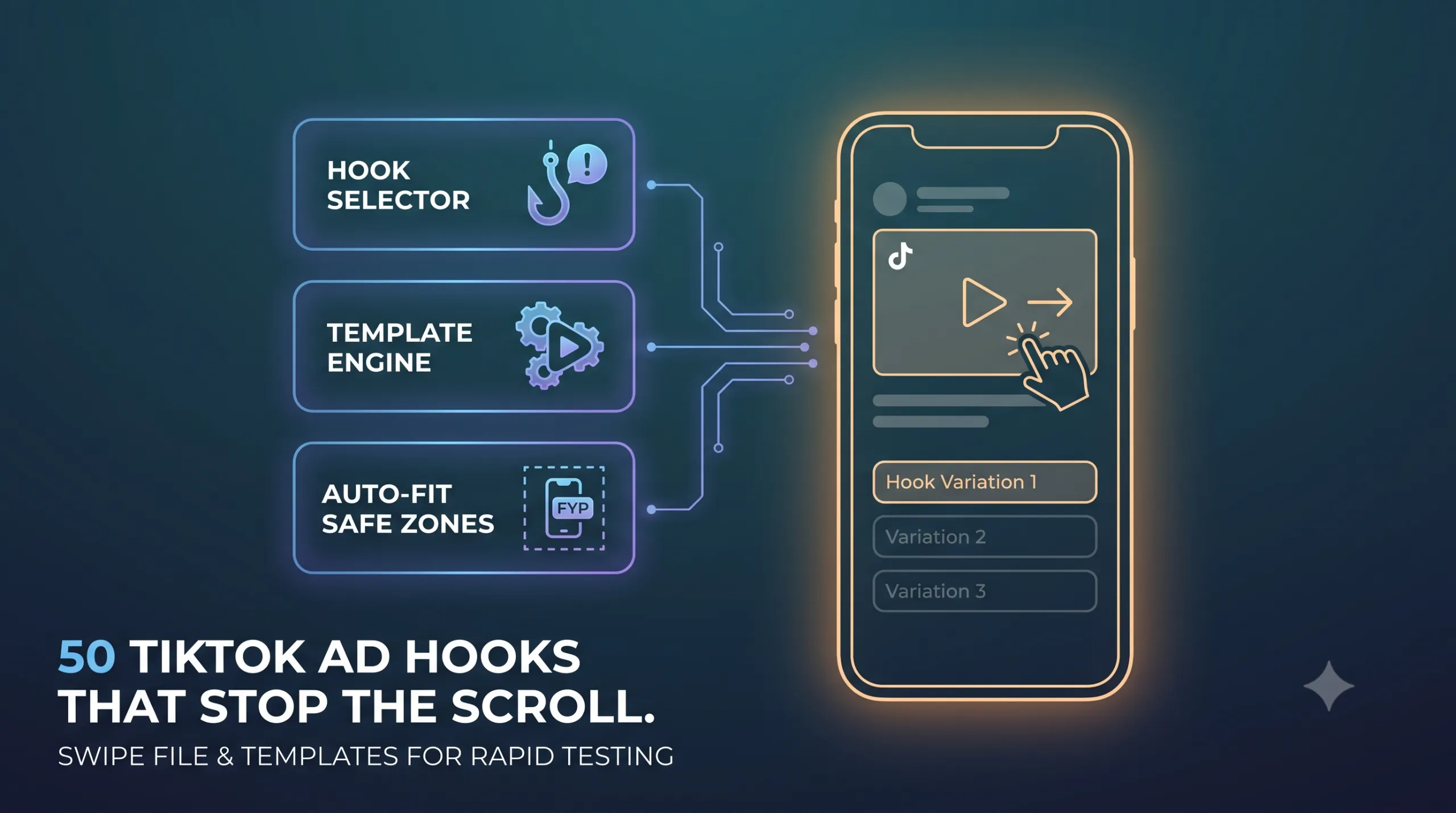
The fastest way to fail at hook testing is by creating manual storyboards for every minor word variation. Manually mocking up visual placements, safe-zone checks, and font contrasts takes hours. To solve this production bottleneck, growth agencies automate their pre-production funnel using dedicated AI ads for TikTok tools. These platforms automate text overlay formatting, check $9:16$ safe zone boundaries, and generate multivariate brief visualizations in minutes rather than days.
Measuring Hook Performance
When evaluating your tests, ignore final conversions (Purchases, ROAS) for the first 48 hours. Focus on the diagnostic metrics that prove your hooks captured and sustained attention.
Pull this funnel data for each variation:
3s View-Through Rate (Thumb-Stop Rate)
$$\text{Thumb-Stop Rate} = \left( \frac{\text{3-Second Video Views}}{\text{Impressions}} \right) \times 100$$
Goal: > 35%
Hold Rate (10s View-Through Rate)
$$\text{Hold Rate} = \left( \frac{\text{10-Second Video Views}}{\text{Impressions}} \right) \times 100$$
Goal: > 15%
If an ad has a high Thumb-Stop Rate but a low Hold Rate, your hook stopped the scroll but the video body failed to deliver on the hook’s promise. Fix the transition. If both metrics are high, you have a winner. Shift that specific combination into your scaling campaigns and raise the budget.
Conclusion
The secret to scaling on TikTok isn’t complexity; it’s velocity. Don’t let your production pipeline become the bottleneck. Use this swipe file to generate copy variations instantly, and build a pre-production pipeline that can visualize and validate these concepts quickly.