The TikTok Ad Hook Blueprint: A Guide for Creative Strategists

Every creative strategist has been there: You spend hours building a beautiful, highly detailed brief. The media buyers are ready with clean account structures, the budgets are allocated, and the creator delivers raw footage that looks visually stunning.
But when the campaign goes live, the diagnostic metrics tell a painful story:
- 3-Second View-Through Rate (Thumb-Stop Rate): 12%
- Average Watch Time: 1.8 seconds
- Outbound Click-Through Rate (CTR): 0.4%
The ad is dead on arrival. Why? Because in modern vertical feeds, the battle for conversion is won or lost before the viewer even knows what product you are selling.
For a creative strategist, mastering tiktok hook psychology is the highest-leverage skill you can develop. It is the literal difference between an ad that gets suppressed by high bid auctions and one that scales profitably.
This comprehensive guide breaks down the exact psychological triggers that govern human feed behavior, how to design visual pattern interrupts, and how to build a repeatable tiktok hold rate optimization pipeline that consistently delivers winning creative.
1. The Psychology of the Scroll: Why Users Stay or Skip
To engineer a hook that works, you have to understand the mental state of a user browsing TikTok.
Unlike users on search engines who have high intent (e.g., searching “best project management software”), social feed users are in a passive, high-dopamine, low-friction browsing state. They are scrolling continuously, making split-second decisions to stay or skip every 1.5 seconds.
In this environment, the human brain relies heavily on predictive processing. It builds a subconscious template of what an “ad” looks like. The moment it detects a highly polished brand logo, a generic studio background, or a corporate spokesperson smiling, the brain registers a pattern match for “advertisement.” It instantly triggers a skip.
[ Active Scroll State ] ──► [ Detects Corporate Pattern (Logo/Stock Shot) ] ──► [ Instant Skip ]
                                         │
                                         ▼
                             (PATTERN INTERRUPTION)
                                         │
                                         ▼
[ Active Scroll State ] ──► [ Detects Novel Visual / Raw Context ] ──► [ Pause to Resolve ]
To stop the thumb, you must create a prediction error—a visual or conceptual pattern interrupt that breaks feed expectations and forces the brain to pause and resolve what it is seeing.
2. The NERV Framework: The Creative Strategist’s Audit Tool
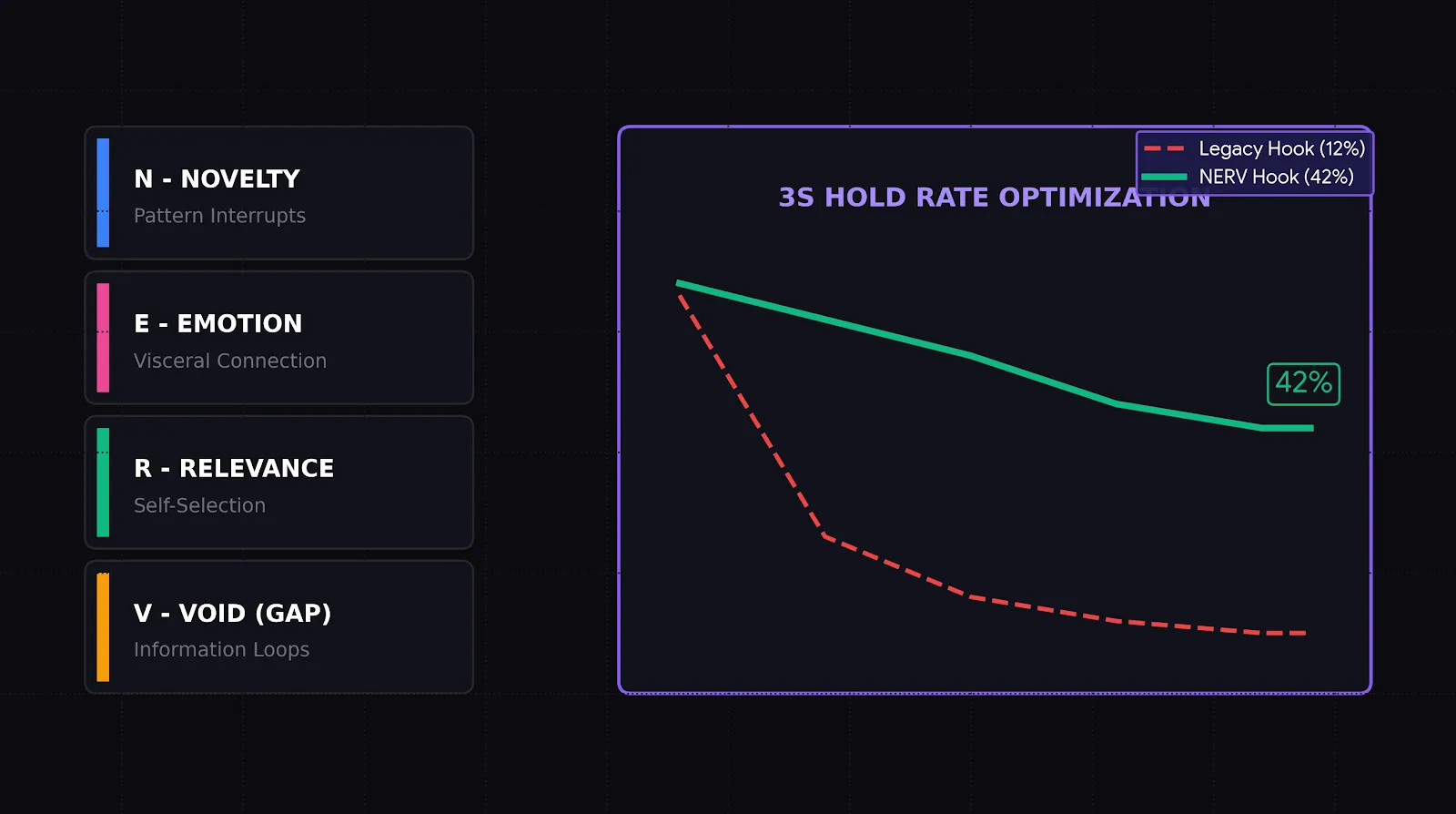
Before handing a script to an editor or creator, you need a objective, data-driven framework to evaluate the opening 3 seconds of your brief. At PixelPlot, we use the NERV Framework to audit the performance potential of every hook.
I. Novelty (Pattern Interruption)
Does the first frame look drastically different from the typical organic content on the user’s feed?
- How to apply it: Avoid high-end cinematic studio lighting. Instead, start with a raw, handheld smartphone angle, a screen-share recording of a chaotic dashboard, or an unusual close-up action (e.g., pouring, cutting, dropping something).
II. Emotion (Visceral Mirroring)
Humans are biologically wired to look at other human faces, especially when those faces display intense, clear emotions.
- How to apply it: Open with a creator expressing deep frustration (sighing, rubbing their temples), shock (eyes wide, looking at a screen), or immediate relief. This triggers mirror neurons in the viewer, pulling them into the narrative instantly.
III. Relevance (Self-Selection)
The user must immediately understand that the content is directly relevant to their specific lifestyle, job, or core problem.
- How to apply it: Use direct, high-contrast on-screen text to qualify your viewer.
- Bad: “Our software is great.”
- Good: “If your team is still manually updating client reporting spreadsheets…”
IV. Void (The Information Gap)
A great hook creates an open loop in the viewer’s mind. The brain is inherently uncomfortable with unresolved loops and will invest a few more seconds of attention to close them.
- How to apply it: Present an incomplete action or a highly curious, contrarian statement.
- Example: “We completely stopped sending monthly PDF reports, and our client retention actually went up. Here’s why…”
3. Real-World Case Studies: Creative Strategist TikTok Hooks in Action
Let’s analyze a few practical tiktok video hook examples to see how subtle shifts in framing and copywriting can dramatically optimize metrics.
Case Study A: The Direct-to-Consumer (DTC) Physical Product
- The Original Hook: A high-quality studio shot of a skincare bottle resting on a marble slab, accompanied by soft music.
- Result: 14% Thumb-Stop Rate.
- The Optimized Hook: A raw, macro close-up of a finger squeezing a dollop of green cream directly onto a mirror, with a creator’s face reflected in the background looking incredibly skeptical.
- Result: 42% Thumb-Stop Rate.
- Why it worked: The original hook felt like a traditional TV commercial, triggering instant ad-blindness. The optimized hook used sensory visual novelty (squeezing cream on a mirror) and a relatable human emotion (skepticism) to build a curiosity gap.
Case Study B: The B2B SaaS Platform
- The Original Hook: A screen recording of a clean software platform dashboard with a voiceover saying, “Welcome to our new project management tool.”
- Result: 8% Thumb-Stop Rate.
- The Optimized Hook: A screenshot of an inbox filled with 147 unread Slack notifications, with bold red on-screen text reading: “How we cut our internal Slack notifications to zero.”
- Result: 38% Thumb-Stop Rate.
- Why it worked: The optimized hook led with a highly recognizable, painful visual (the red notification badge) that immediately qualified the target audience, establishing relevance in under half a second.
4. The Creative Strategist’s Workflow for Hold Rate Optimization
To run a world-class creative department, you cannot rely on one-off viral hits. You need a systemized, highly repeatable pipeline for testing and optimizing.
┌───────────────────────────────┐
│ 1. Deep Audience Research     │ ──► Identify core anxieties, friction points
└───────────────┬───────────────┘
                ▼
┌───────────────────────────────┐
│ 2. Create the Modular Brief   │ ──► Keep 1 core ad body; draft 3-5 hook variations
└───────────────┬───────────────┘
                ▼
┌───────────────────────────────┐
│ 3. Automated Pre-Production   │ ──► Generate hooks via AI storyboarding
└───────────────┬───────────────┘
                ▼
┌───────────────────────────────┐
│ 4. Structured ABO Hook Test   │ ──► Deploy on TikTok Ads Manager
└───────────────────────────────┘
Step 1: Mine for Angles, Not Just Copy
Before writing script copy, map out the primary friction points of your target demographic. Look through customer support tickets, search query histories, and competitor review sections. Find the exact phrases your target buyers use to describe their frustrations.
Step 2: Write Modular Briefs
When you brief your video editors or creators, structure your assets modularly. Do not ask for five distinct videos. Instead, request one unified ad body (which delivers your core value proposition and call to action) and three to five highly contrasting 3-second hooks.
This keeps production costs low while maximizing creative output.
Step 3: Implement Automated Pre-Production
To visual the pacing, framing, and on-screen text formatting before spending time in post-production, leverage automated storyboarding. This allows you to verify that your visual hooks are properly formatted for vertical viewing dimensions and that safe-zones remain completely unobstructed.
Step 4: Run Structured Tests
Work closely with your media buying team to set up a dedicated Ad Group Budget Optimization (ABO) campaign on TikTok. Feed your different hook variations into separate ad groups with identical targeting budgets. This isolates the hook as the single variable, giving you clean, unpolluted performance diagnostics.
5. The Future of Agile Creative Strategy
The landscape of paid social advertising is moving at a speed that traditional agency structures simply cannot support. If your creative team takes two weeks to conceptualize, approve, shoot, and edit a set of ad variations, you will inevitably fall behind the algorithmic fatigue curve.
The future belongs to the agile, platform-native creative strategist who can merge deep psychological insights with high-velocity production automation.
By restructuring your pipeline around modular variations, you can leverage tools to build high-converting AI ads for TikTok that auto-format, write high-impact hooks, and fit native safe-zones out of the box.
Combine this high-speed generation engine with a deep library of copy-and-paste TikTok ad hooks to build an unstoppable direct-response loop—drastically lowering your acquisition costs and driving predictable scale for your business.
Optimize Your Production Velocity
Want to streamline your creative pipeline even further? Discover how to visually organize your modular ad scripts, map native social layouts, and eliminate production bottlenecks in our ultimate guide to building a TikTok ad storyboard template today.