AI Storyboarding for Ads

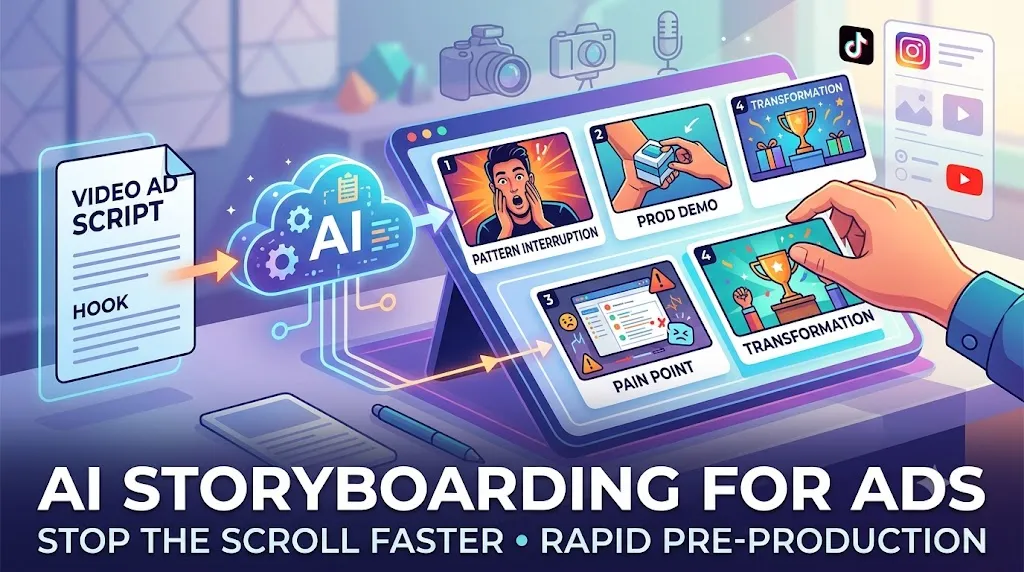
AI Storyboarding for Ads: The Modern Marketer’s Guide to Rapid Pre-Production
If your short-form ads are draining your production budget before you even hit the “Publish” button, you don’t have a creative problem—you have a pre-production bottleneck.
In performance marketing, speed is everything. Testing five variations of a hook or swapping out visual assets shouldn’t require a three-day turnaround from an expensive design team. Yet, the traditional method of storyboarding—painstakingly sketching out frames by hand or sourcing countless, mismatched stock images—frequently delays campaigns.
Enter AI storyboarding for ads.
By leveraging generative intelligence, growth teams, DTC brands, and agile creative agencies can now translate a raw marketing script into a fully visualized, frame-by-frame storyboard in minutes. This shift isn’t just about saving time; it’s about transforming how performance creative is conceptualized, tested, and scaled.
This comprehensive guide breaks down how to build an optimized AI storyboarding workflow, mirror cutting-edge attention psychology in your visual frames, and eliminate the costly friction between your script ideas and final ad delivery.
1. What is AI Storyboarding for Ads?
Traditional storyboarding acts as a visual blueprint for video production. It aligns the director, videographer, and editor on framing, composition, and narrative progression.
AI storyboarding automates the heavy lifting of asset generation within this process. Instead of drafting mockups or building chaotic mood boards, an AI script to storyboard converter processes your text, identifies scene transitions, and automatically generates high-fidelity, contextually accurate visual frames.
[ Text Script ] ──( AI Processing )──> [ Visual Storyboard ] ──> [ Unified Team Alignment ]
For performance marketers, an AI storyboard generator for video ads does something a human designer cannot do instantly: it maintains structural consistency while rapidly iterating on visual concepts. Whether you need to visualize a TikTok UGC ad, a high-polish Instagram Reel, or an intent-driven YouTube Shorts sequence, AI bridges the gap between text-based concepts and a visual reality.
2. Why Traditional Storyboarding Fails the Social Algorithm
The fast-moving world of social commerce and digital advertising moves too quickly for legacy design methodologies. Relying on classic storyboarding approaches for ad creative creates major execution gaps:
- Prohibitive Latency: Waiting days for storyboards prevents marketing teams from responding dynamically to rapid market shifts, viral audio trends, or sudden competitor pivots.
- The Cost of Iteration: If you want to test three distinct visual variations of a hook, a human designer has to draw three separate sequences. With AI, generating alternate angles or swapping out core props takes seconds.
- Contextual Disconnect: Standard storyboards are built for horizontal, cinematic spaces. They rarely account for vertical screen dynamics ($9:16$), native platform overlays, text safe zones, or the rapid pacing required by modern mobile feeds.
Automated storyboarding for marketing directly resolves these structural issues. It provides immediate visual feedback, allowing growth teams to audit and refine creative concepts before allocating a single dollar to filming or asset procurement.
3. The Core Pillars of an Effective AI Storyboard
To generate high-ranking, high-converting creative assets, your AI storyboard must be built on explicit parameters. It cannot simply be a collection of abstract, visually interesting AI art pieces. To properly guide your production team or text-to-video models, every frame must satisfy three key architectural principles:
A. Strict Framing and Composition Guidelines
The AI must understand the final medium. If you are developing a TikTok ad storyboard template, the prompt generation needs to enforce $9:16$ aspect ratios, close-up framing, and intentional placement of the human subject. Busy compositions with cluttered backgrounds fail on mobile; the eye needs a clear, singular focal point that resolves in under half a second.
The eye needs a clear, singular focal point that resolves in under half a second. If you are building campaigns for social media, utilizing a dedicated TikTok ad storyboard template ensures your creative elements stay within safe zones.
B. Serial Visual Consistency
The single greatest challenge in generative AI workflows is maintaining continuity across sequential generations. When building an AI animatic maker for social ads, ensuring that characters, product packaging, and primary environments look identical from Frame 1 to Frame 5 is vital. Utilizing advanced model parameters like persistent seed numbers, character reference codes (--cref), and highly structured style prompts ensures your storyboard reads as a cohesive narrative rather than a disjointed slideshow.
C. Seamless Copy and Subtitle Integration
A storyboard is incomplete without its audio and text tracks. Modern AI storyboarding tools explicitly separate the visual prompt from the accompanying on-screen text (OST), voiceover (VO) instructions, and sound effects (SFX). This guarantees that every visual shift aligns perfectly with your script’s narrative pacing and verbal hooks.
4. Step-by-Step Workflow: Transforming a Script into an AI Storyboard
Building an efficient, repeatable pipeline using text to storyboard AI free or premium options requires a systematic workflow.
┌──────────────────────────┐
│ 1. Structuring the Script│
└─────────────┬────────────┘
              ▼
┌──────────────────────────┐
│ 2. Parsing the Prompts   │
└─────────────┬────────────┘
              ▼
┌──────────────────────────┐
│ 3. Batch Asset Generation│
└─────────────┬────────────┘
              ▼
┌──────────────────────────┐
│ 4. Platform Safe-Zones   │
└─────────────────────────┘
Step 1: Structure Your Script for the Machine
Do not feed a giant block of prose into an AI engine. Break your script down into a highly modular table or JSON format. Isolate each critical beat by its exact timestamp, intended visual action, voiceover line, and targeted screen text.
Step 2: Formulate Visual Prompts for Scene Generation
Translate your narrative action into direct, descriptive prompts optimized for image generation engines. Avoid vague marketing buzzwords like “engaging” or “dynamic.” Instead, use descriptive, physical terminology:
- Weak Prompt: “An engaging video ad showing a happy customer using our software.”
- Optimized Prompt: “A close-up shot of a 30-year-old woman sitting at a desk, looking at a laptop screen with a expression of sudden relief. Clean modern office lighting, cinematic composition, $9:16$ aspect ratio.”
Step 3: Run Batch Generations for Consistency
Utilize batch processing features within your chosen AI suite to output multiple variants of your sequence simultaneously. This approach lets you quickly discard visual anomalies and lock down a unified aesthetic across your timeline.
Step 4: Overlay Platform-Specific Safe Zones
Before finalizing the storyboard layout, apply semi-transparent masks that replicate the actual UI overlays of TikTok, Instagram Reels, or YouTube Shorts. This step prevents your core visual hooks or crucial call-to-action text from being covered by interactive platform buttons, profiles icons, or comment feeds.
5. Integrating Hook Psychology into Your Canvas
The most critical asset in your entire storyboard is the very first frame. If your opening sequence fails to disrupt the user’s habitual feed scrolling, the rest of your video’s message is effectively lost.
When constructing your storyboard frames, make sure the initial 1–3 seconds are intentionally designed to pass the NERV performance framework, test a pain-point hook directly against a surprise demo hook. For a deep dive into the underlying metrics behind this strategy, see our complete guide on Video Hook Psychology to learn how to fix a failing hold rate.:
| Attention Lever | Storyboard Implementation | Expected Audience Action |
| Novelty | Frame 1 must contrast sharply against generic lifestyle content. Use unexpected close-ups, unique angles, or sudden motion cues. | Pauses the user’s physical scroll. |
| Emotion | Lead with clear human expressions—such as frustration, intense relief, or surprise—captured via extreme close-up framing. | Generates immediate empathy and psychological resonance. |
| Relevance | Visually showcase an explicit pain point, relatable lifestyle context, or product application right out of the gate. | Signals to the target viewer that “this is for me.” |
| Void | Construct an information gap by showing an incomplete action or an intriguing setup that requires context to resolve. | Convinces the viewer to invest the next few seconds to see the payoff. |
When using an AI storyboard generator for video ads, explicitly generate two or three entirely different variations for your opening frame. Test a pain-point hook (e.g., a messy workflow screenshot) directly against a surprise demo hook (e.g., a macro view of your product in action) to give your video editing team clear, distinct options to build out for multivariate ad testing.
6. Selecting Your Stack: The Best AI Storyboarding Tools
Depending on your production volume, budget, and specific technical infrastructure, multiple approaches exist for assembling your AI creative toolkit:
All-in-One AI Marketing Suites
Dedicated ad-tech platforms leverage fine-tuned models tailored specifically for performance marketing workflows. These tools automatically parse uploaded scripts, maintain character and product asset consistency out-of-the-box, and apply native social media safe-zone overlays seamlessly.
Modular Generative Stacks
For creative directors who want complete artistic control, a modular stack offers deep flexibility:
- Script Structuring: Leverage advanced LLMs to transform long briefs into cleanly segmented, multi-frame scripts.
- Visual Frameworks: Use raw generative engines to craft high-fidelity, stylistically unified imagery.
- Layout and Assembly: Compile the final outputs into collaborative design spaces like Figma or Canva to add voiceover tracking notes, precise timestamps, and editing directives.
7. The Future of Video Production: From Static Frames to AI Video
Storyboarding is no longer just a passive guide for human camera crews. In the modern creative pipeline, static AI-generated storyboard frames serve as the foundational source assets for advanced text-to-video and image-to-video generation tools.
By perfecting your storyboarding workflow today, you are future-proofing your entire marketing division. Locking down a precise sequence of structured, highly consistent AI frames allows you to plug those images directly into video generation models. This lets you synthesize finished, hyper-targeted video variations at scale without ever needing to coordinate a physical camera shoot or manage an expansive post-production lifecycle.
Embracing automated pre-production gives your brand a massive competitive edge—allowing you to scale your creative volume, radically slash production costs, and run circles around the social media algorithms.